
Searching the Ephraim Court Docket
Read the paperwork first. Whatever court is printed there tells you where the case lives. A city citation belongs to Ephraim Justice Court. But a felony, a Class A misdemeanor, or a major civil matter goes to Utah District Court instead. For public Utah District and Justice Court case information, use Utah Courts Xchange. One caution applies, though. Xchange is paid public access, not the city calendar and not a complete case file. Its case and citation numbers are not unique statewide. So filter for the Ephraim location before trusting a match.
- Copy the court name, citation or case number, party name, and deadline from the notice.
- Select Justice Court in Xchange and narrow the scope to Ephraim.
- Search by number first, or use name, case type, and date fields.
- Compare location, filing date, party role, charge, and latest event.
- Call the Ephraim clerk when a result or setting conflicts with the notice.
Parties to a case have another option. Through MyCase, they can view their own filings. Everyone else can visit a courthouse terminal or mail a written request to the Utah Judiciary. Each channel meets a different need. None of them turns the Ephraim calendar into a name search.
Ephraim's 30-Day Court Calendar
The Ephraim Justice Court page lists Ephraim court dates for the next 30 days only. It says the calendar is updated daily. Among Sanpete County's five largest cities, this is the clearest local calendar service. Remember what it is, though. It shows settings, not a full Ephraim case history. An empty calendar beyond that range means nothing about whether a matter ended or ever existed.
Need a date farther out? Call 435-283-4631. The statewide Utah court calendar covers an even shorter two-week window. Check both against the latest notice and any Xchange proceedings. When one source shows a reset first, the clerk can say which setting controls.
The official Ephraim Justice Court source lays out the city court calendar and its services.
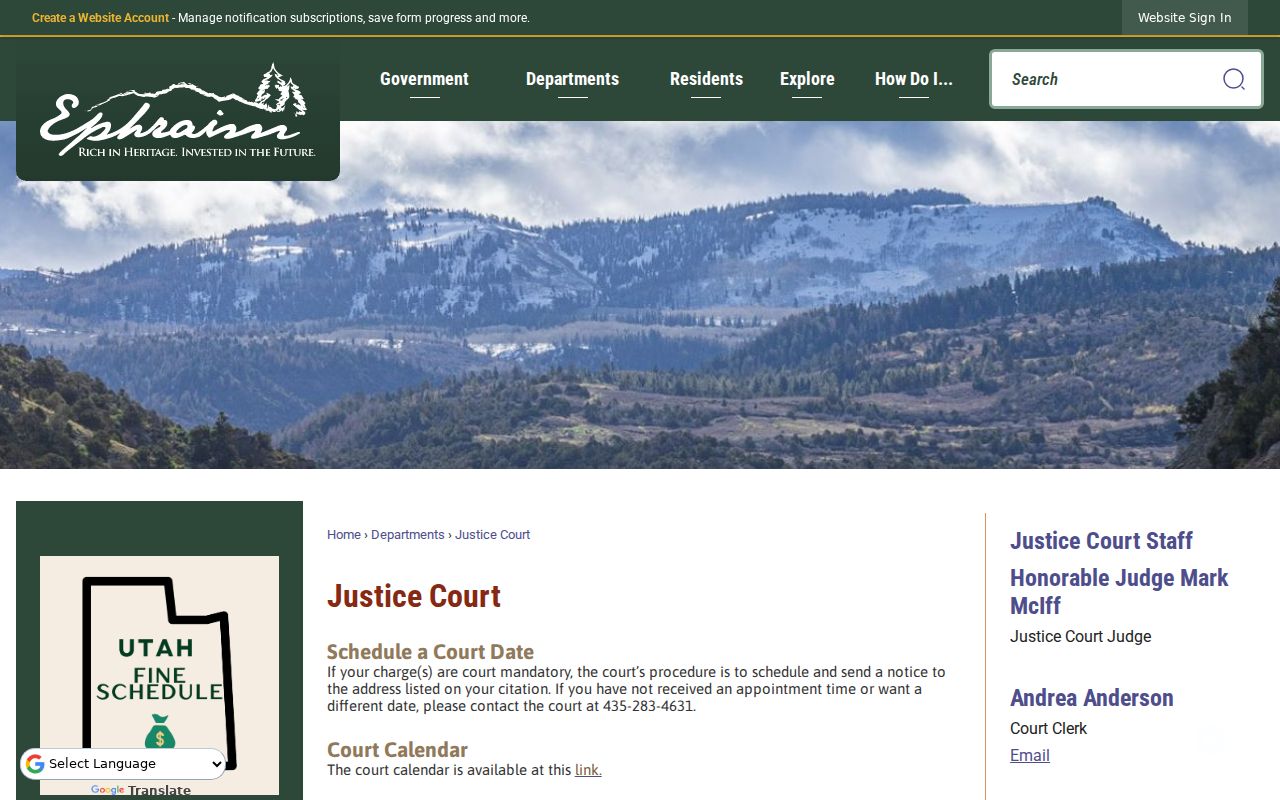
That page makes one distinction clear. Ephraim offers a date-limited calendar with direct contact, not a general free name search of every city case.
Note: A daily update can trail a late court change, so confirm any conflict before traveling or missing a deadline.
Ephraim Municipal Court Basics
The city's court is officially the Ephraim Justice Court. Its docket covers most traffic citations, local ordinance cases, and infractions. Class B or C misdemeanors land there too. The official listing names Judge Mark McIff, clerks Andrea Anderson and Jessica Arnoldson, and prosecutor Wes Mangum. Those names identify the public office. They do not prove who will hear any given setting.
Ephraim Justice Court
5 S. Main St.
Ephraim, UT 84627
435-283-4631
Fax: 435-283-4867
For municipal dates, payments, and forms, the Ephraim clerk is the direct route. Sixth District files in Manti sit elsewhere, though, outside this clerk's hands. The Sanpete County Clerk handles county administrative records, not this city case docket.
Ephraim Court Notices by Mail
Ephraim mails mandatory court notices to the address printed on the citation. Missed an appointment or need a different date? Contact court staff directly. That local practice gives you a source beyond the online calendar. It also makes the address on the citation matter. Stale contact information can break the notice chain.
No appointment notice? Call the Ephraim Justice Court. Do not infer that a case vanished because no letter arrived or the 30-day calendar is blank.
Keep the citation and the mailed paper side by side. Check the number, court name, hearing date, and response deadline against the Ephraim docket entry. A phone confirmation helps, but it cannot erase a written deadline or replace a court order.
Court Dates and Settings in Ephraim
An Ephraim court date is a set of matching fields, never a date alone. The city FAQ describes a familiar rhythm: first Wednesday and third Monday afternoons, plus fourth Wednesday mornings with Judge McIff. It also warns that the schedule can change. The pattern may explain why a date looks familiar. It never promises a specific case will be heard then.
| Date | The latest date on the Ephraim calendar, notice, and case history. |
|---|---|
| Time | The stated appearance time, which may differ from another docket call. |
| Court | Ephraim Justice Court, not county justice or Sixth District Court. |
| Judge | The assigned judicial officer shown for that setting. |
| Setting Type | Arraignment, pretrial, motion, trial, sentencing, or review. |
See the words continued, reset, or passed on an entry? Hunt for the newest event, since the first date may be obsolete. When official sources disagree, call Ephraim staff.
Ephraim's Recurring Docket Pattern
The recurring session pattern helps with planning, but keep it in context. Holidays, judicial assignments, case needs, and later orders can all shift the rhythm. Never calculate an Ephraim court date from a familiar weekday when no official notice or current calendar shows one.
A sound check uses three layers. Read the mailed notice, then review the Ephraim 30-day calendar, and then inspect Xchange proceedings if public access fits your situation. Call the clerk when the layers differ. That habit stops you from treating a usual schedule as proof, and it keeps a city setting from getting confused with a Manti hearing.
Traffic Tickets in Ephraim
A traffic ticket in Ephraim usually names the court. It also lists the citation number, the violation, and the deadline to pay or appear. Search under the named Ephraim location, because citation numbers can repeat across Utah courts. Xchange can expose public history. Meanwhile the city page supplies the local calendar plus payment and form instructions. Utah's ePayments service is another possible route, though not every matter qualifies.
Paying and contesting are different choices. Paying counts as a finding of guilt rather than a dismissal. Contesting sends you through the court's plea and appearance process. If traffic school is on your mind, Ephraim warns against paying online before calling first. The Sanpete County traffic ticket page covers the county-wide route.
- Pay in person at Ephraim City Hall.
- Mail a check under city instructions.
- Use the phone card route.
- Use the linked online route only after checking eligibility.
Confirm the name and the Ephraim location before you pay anything. A mismatch calls for a clerk call, not repeated attempts.
Ephraim Plea and Extension Options
Fines vary by case. A payment plan needs a judge's authorization, and a clerk may grant only a short extension. A plea in abeyance can run up to one year. None of this is automatic. Terms come from the court's order. Relief ends if you break them. Utah also offers deferred traffic prosecution to eligible drivers, with strict timing and conditions. That is not an Ephraim plea in abeyance. Ask staff which route fits before you pay or enter a plea, then read the docket later for the actual disposition rather than assuming a result from a program summary.
Where Ephraim Cases Go
Not every Ephraim case stays in the city. Utah District Court takes the heavy matters: felonies, Class A misdemeanors, major civil disputes, domestic cases, and probate. Sanpete County Justice Court keeps its own county cases. Juvenile matters sit in a separate court. Those files carry stricter privacy rules. When in doubt, the court named on your first court paper is the best routing clue.
Docket flow: Ephraim Justice Court › Sanpete County courts › Utah District Court
An empty Ephraim result often means the case sits elsewhere. Try the proper District or Justice jurisdiction in Xchange, with the exact court location chosen. The Sanpete County court docket home page compares the venues. Federal matters use PACER. They fall outside this flow.
Ephraim's Official Forms Shelf
The city court page links a whole shelf of forms: rights-waiver, expungement, garnishment, indigency, payment-plan, Spanish-rights, and plea-waiver materials. Each document does one job. A payment-plan form does not pull a case file. An expungement petition leaves the Ephraim docket untouched until the legal process runs its course. Use the current version the city links, and follow the filing route Ephraim staff describe. Want a copy of an existing public record? Make a records request. For a District Court record, contact Manti records staff instead of sending a city form to the wrong office.
Ephraim's 2018 Docket Snapshot
The official FY2018 justice report counted 130 criminal filings, 7 general civil filings, and 580 traffic or parking filings at Ephraim Justice Court, for 717 total. Those old numbers are not a forecast. They do show something practical. An Ephraim docket search needs a strong traffic route, while criminal and civil matters still demand coverage too.
Ephraim counted 5,611 people in the 2020 Census, the county's largest incorporated place. That rank says nothing about courts. Population and docket volume measure different things. Neither one finds a current case or predicts how fast it moves. The FY2018 categories show why a broad name search can mislead. Traffic, criminal, and general civil filings use different case codes. A city total hides whether a record stays public. For current Ephraim work, pick the known case type. Compare the court location. Read the dated proceedings. Historical totals are civic context only. They cannot show that a person had a case, that a filing remains open, or that today's docket follows the same mix.
Ephraim Court Record Access Rules
Public access to Ephraim court records runs on Utah's own court rules. UCJA Rule 4-202.02 sorts records into public, private, protected, sealed, juvenile, and restricted classes. Rule 4-202.04 covers written requests and how to identify the record you want. Sealed, expunged, juvenile, and private material stays closed. Closure holds even when a related case appeared online.
Access route: Ask Ephraim Justice Court for its municipal file. Use Xchange for public case information, a courthouse terminal for free inspection where available, or the Judiciary request form for a specific record.
A dismissal does not expunge the public index by itself. Ephraim's FAQ says a record can linger after dismissal until expunged. Utah GRAMA covers many government records. Court cases follow the judiciary's classification rules instead. Send each request to the right office. It must be the one that actually keeps the record.